Konkrete Ausgangslage
Der Use Case lohnt sich, wenn wiederkehrende Aufgaben heute manuell geprüft, kopiert, beantwortet oder zwischen Systemen weitergereicht werden.
 ConsultingServices.aiAI Consulting for SMEs
Use Case in Detail
Complex infrastructures generate millions of event logs daily. The result: alert fatigue, slow responses (MTTR), and constant fire-fighting. AIOps (Artificial Intelligence for IT Operations) correlates these events in real-time, filters out noise, and proactively manages troubleshooting.
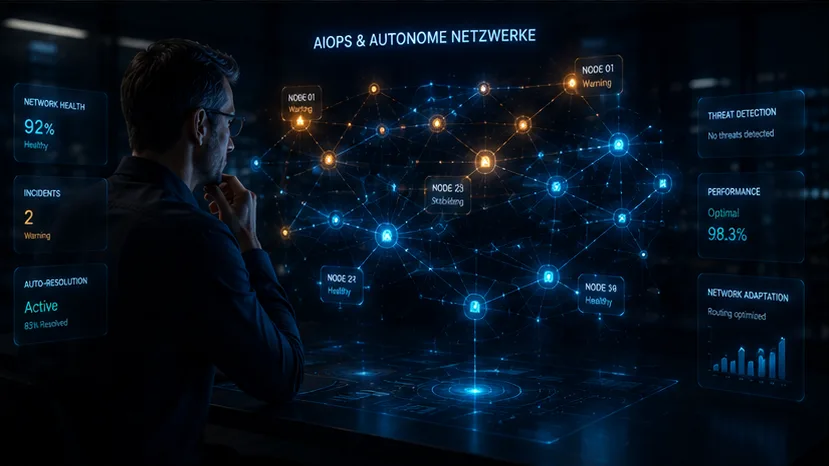
Deployment of a comprehensive AIOps platform that consolidates network, infrastructure, and application metrics. Machine learning analyzes topologies, logically correlates symptoms, and reduces thousands of alerts to a few real incidents. Optionally, self-healing scripts can automatically trigger restarts.
Less suitable if: You operate a highly simplified, non-redundant server architecture where rudimentary uptime pings are conceptually sufficient.
Business Impact
Drastic reduction of irrelevant system ping messages in favor of real crisis visibility.
Mean time to repair drops dramatically as AI directly identifies the root cause during outages.
Hidden bottlenecks (e.g., memory leaks) are detected by AI before the server crashes.
The Solution in Practice
How AI seamlessly and securely integrates into your business processes.
Collection and centralization of all log files, metrics, and traces from networks, databases, and app clusters without loss of information.
AI visualizes dependencies: A broken switch triggers 1000 server timeouts. AIOps logically summarizes this as a granular network incident.
Through secure webhooks, the system autonomously executes fallback routines, auto-scaling, or service restarts for standardized errors (self-healing).
Frequently Asked Questions
No, the setup is gradual. Stage 1 is pure visibility & root cause marking. Stage 2 involves "Click-to-Approve" runbooks for your admins. Only in Stage 3 do you grant the AI approval for autonomous self-healing for non-critical backend services.
On the contrary. AIOps does not replace tools like Datadog, Dynatrace, PRTG, or Zabbix. It acts as a "manager of managers," integrating via APIs and deriving overarching insights from the metrics of these excellence tools.
Is your IT trapped in reactive fire-fighting mode? Book a potential consultation to end alert fatigue and bring autonomy to your network.
Vertiefung
Damit ein Use Case nicht nur interessant klingt, muss er in Prozessvolumen, Datenlage, Risiko und messbarer Wirkung übersetzt werden.
Der Use Case lohnt sich, wenn wiederkehrende Aufgaben heute manuell geprüft, kopiert, beantwortet oder zwischen Systemen weitergereicht werden.
Der wirtschaftliche Hebel entsteht meist aus eingesparter Bearbeitungszeit, weniger Fehlern, schnellerer Reaktionszeit und besserer Auslastung vorhandener Teams.
ROI-Beispiel
Das entspricht rund 24.000 EUR manuellem Jahresaufwand. Bei 30 Prozent Entlastung entsteht ein rechnerisches Potenzial von ca. 7.200 EUR pro Jahr.
Die tatsächliche Wirtschaftlichkeit hängt von Prozessvolumen, Datenqualität, Integrationsaufwand und Freigabeanforderungen ab.