Konkrete Ausgangslage
Agenten lohnen sich, wenn Mitarbeitende mehrstufige Routinen zwischen E-Mail, CRM, ERP, Tabellen und Webportalen ausführen, aber Entscheidungen klar regelbar sind.
 ConsultingServices.aiAI Consulting for SMEs
Use Case in Detail
Generative chatbots only write texts. Autonomous agents act. They monitor mailboxes, extract purchase intents from emails, retrieve real-time inventory from the ERP, and independently create quotes or support tickets in your systems – all with built-in "Human-in-the-Loop" approval loops.
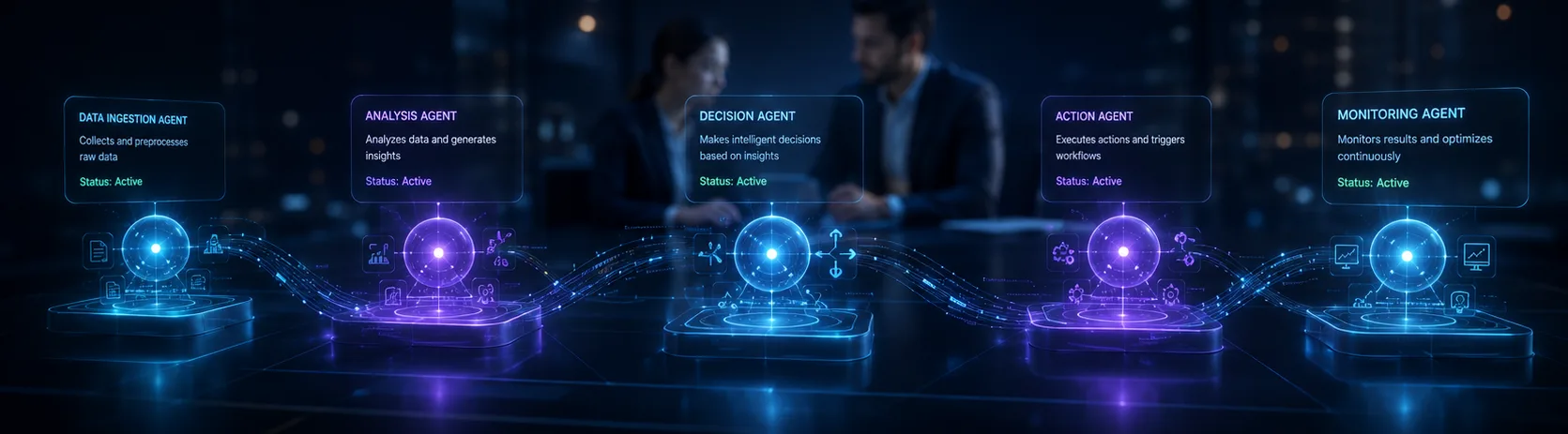
An AI agent with API access. It receives a task (e.g., "Process complaint emails"), reads the email, independently checks the invoice in the ERP, creates a return label in the logistics system, and drafts a response email. The employee only needs to review briefly and click send.
Less suitable for: Exclusively manual (paper) processes completely without digital systems for API integration or cases where every customer contact is absolutely unique.
The Solution in Practice
Reads the email "Please order 2x Pump X for Project Y". Checks the ERP inventory via API, creates a disposition, and saves a draft of the confirmation email. The salesperson just clicks "Send".
A form is submitted. The agent automatically researches the company size online, cross-references the data in Salesforce/Hubspot, and assigns a score to the lead before sales starts.
Unlike the hype, B2B agents do not operate unchecked. They prepare complex task chains for signature. The final approval click for the transaction often remains (for now) with the human.
Ready to completely chain processes? We build secure AI agents that integrate into your ERP and CRM.
Vertiefung
Damit ein Use Case nicht nur interessant klingt, muss er in Prozessvolumen, Datenlage, Risiko und messbarer Wirkung übersetzt werden.
Agenten lohnen sich, wenn Mitarbeitende mehrstufige Routinen zwischen E-Mail, CRM, ERP, Tabellen und Webportalen ausführen, aber Entscheidungen klar regelbar sind.
Der Hebel liegt in Prozessbeschleunigung, weniger Medienbrüchen und geringeren Fehlerkosten. Der Pilot sollte nicht vollautonom starten, sondern mit Entwurf, Prüfung und Freigabe.
ROI-Beispiel
Der manuelle Jahresaufwand liegt bei ca. 64.800 EUR. Bei 40 Prozent Entlastung ergibt sich ca. 25.900 EUR Potenzial pro Jahr.
Solide Agenten-Projekte starten mit Assistenz und Freigabe, nicht mit unkontrollierter Vollautomatisierung.