Konkrete Ausgangslage
Der Use Case lohnt sich, wenn wiederkehrende Aufgaben heute manuell geprüft, kopiert, beantwortet oder zwischen Systemen weitergereicht werden.
 ConsultingServices.aiAI Consulting for SMEs
Use Case in Detail
Rising cost pressure combined with increasing cloud and on-prem complexity paralyzes budgets. Often, there is a lack of transparency regarding inefficient resource utilization. AI-powered FinOps analyzes your spending in real-time, detects anomalies beyond static budgets, and automates the effective rightsizing of your IT infrastructure.
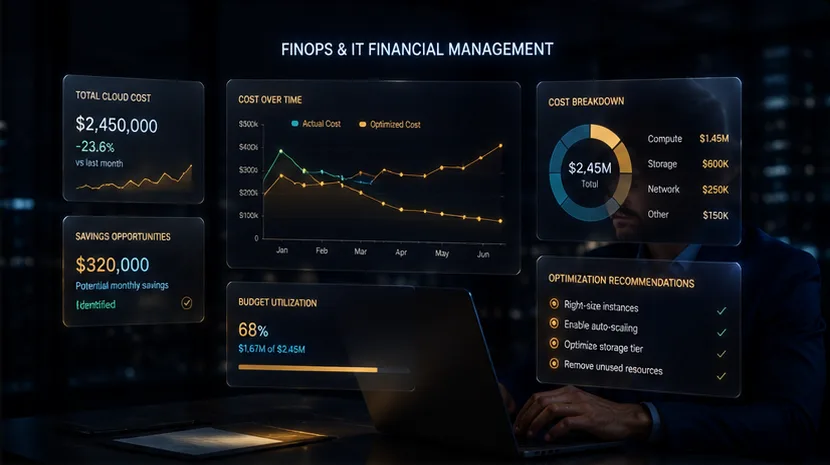
An AI-powered FinOps platform dynamically aggregates all billing data (multi-cloud & on-prem). Machine learning models (anomaly detection) immediately alert during cost spikes. The AI provides concrete rightsizing recommendations ("Downgrade VM in Zone X") or automates these via infrastructure-as-code workflows.
Less suitable if: Your IT consists 100% of fully depreciated bare-metal servers without any variable load or cloud metrics.
Business Impact
Reduction of unnecessary expenses through immediate detection of unused resources (orphaned assets).
Cost outliers are identified in minutes instead of on the monthly bill.
Predictive models calculate exact future budgets based on historical telemetry.
The Solution in Practice
How AI seamlessly and securely integrates into your business processes.
Consolidation of all cost and telemetry data in a central data lake with automated AI tagging for erroneous allocations.
The ML model learns normal usage behavior and immediately alerts the FinOps team of suspicious utilization or cost outliers.
Based on predictive load analyses, the AI generates pull requests (e.g., Terraform) to resize over-provisioned instances during off-peak times.
Frequently Asked Questions
No. By default, the FinOps AI operates as an advisor in "read-only" mode. It provides precise dashboards and generates alerts or change requests via ticket. Only when full trust is established do you allow auto-remediation (e.g., automatically pausing dev resources at night).
The leverage is highest in public clouds due to variable costs. However, in on-premise infrastructures, AI significantly helps with capacity planning (When should hardware be reordered?) as well as load and energy optimization (smart cooling).
Are you losing track of cloud expenses? Let's talk about automated cost control and intelligent resource planning for your company.
Vertiefung
Damit ein Use Case nicht nur interessant klingt, muss er in Prozessvolumen, Datenlage, Risiko und messbarer Wirkung übersetzt werden.
Der Use Case lohnt sich, wenn wiederkehrende Aufgaben heute manuell geprüft, kopiert, beantwortet oder zwischen Systemen weitergereicht werden.
Der wirtschaftliche Hebel entsteht meist aus eingesparter Bearbeitungszeit, weniger Fehlern, schnellerer Reaktionszeit und besserer Auslastung vorhandener Teams.
ROI-Beispiel
Das entspricht rund 24.000 EUR manuellem Jahresaufwand. Bei 30 Prozent Entlastung entsteht ein rechnerisches Potenzial von ca. 7.200 EUR pro Jahr.
Die tatsächliche Wirtschaftlichkeit hängt von Prozessvolumen, Datenqualität, Integrationsaufwand und Freigabeanforderungen ab.