Konkrete Ausgangslage
Der Use Case lohnt sich, wenn wiederkehrende Aufgaben heute manuell geprüft, kopiert, beantwortet oder zwischen Systemen weitergereicht werden.
 ConsultingServices.aiAI Consulting for SMEs
Use Case in Detail
No more 'running to failure' and no over-maintenance. Sensor data, vibration, temperature, and acoustic emissions are analyzed in real-time to accurately predict failures of industrial assets before they stop the production line.
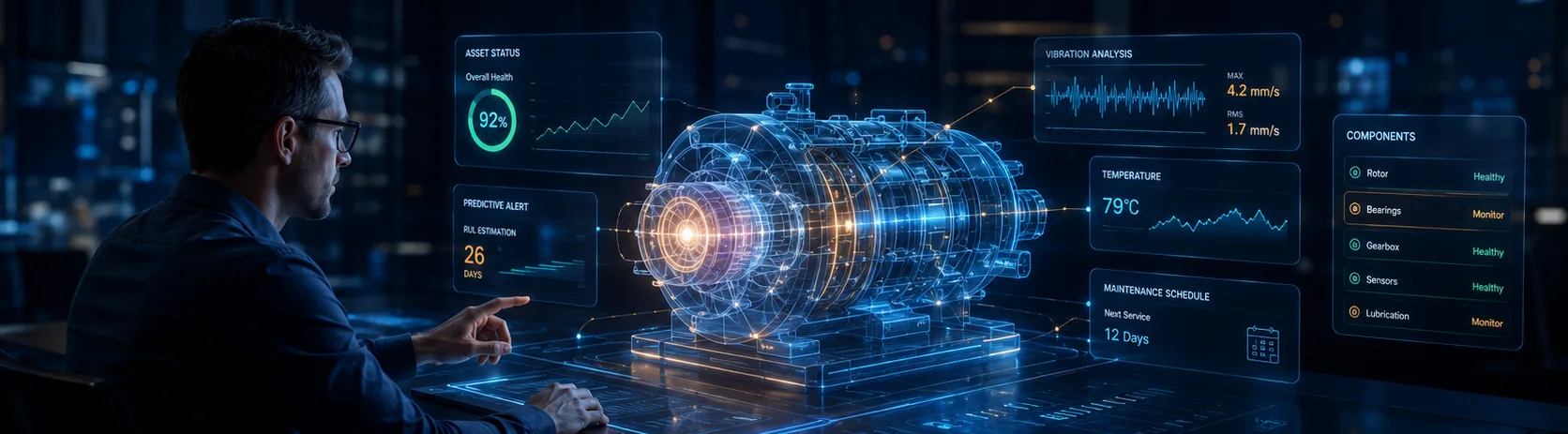
Machine learning processes massively granular IoT data streams at the edge (directly at the machine) or in the cloud. The system detects anomalies in the high-frequency vibration pattern that are not audible or perceptible to the technician and calculates the remaining useful life (RUL).
Less suitable when: Very homogeneous, simple machines where a defective motor costs 50 euros at the nearest hardware store.
Business Impact
Minimizing costly machine accidents during critical shifts.
Replacement only when actual wear is indicated, not by stopwatch.
Extension of the overall usage time of the machinery.
Sensors buffer data; a local edge controller (e.g., AWS IoT / Azure IoT) smooths out the background noise.
Classic thresholds are useless. The machine "jerks" at startup. Deep learning learns real error signatures and differentiates between "normal warm-up" and "fatigue".
Three weeks before failure, the system sends a call via API to SAP PM (Plant Maintenance) or the IT service agent: "Replace rotor C during shift break 2". The spare part is ordered out-of-the-box.
Frequently Asked Questions
Typical problem in phase 1. Tolerance bands are often too strict without real historical "failure data" sets. A "digital twin" thrives on reinforcement – the workshop masters initially feed false alarms back into the cloud until the AI has 99% confidence weeks later.
No problem. A large part of predictive use cases today relies on non-invasive "retro-fit" sensors. A tiny battery sensor for measuring machine vibration is externally attached and connects via LoRaWAN to the gateway. Completely decoupled from the operating code of the 1980s control.
Are unexpected system failures causing you trouble? Evaluate the use of predictive analytics pragmatically with us.
Vertiefung
Damit ein Use Case nicht nur interessant klingt, muss er in Prozessvolumen, Datenlage, Risiko und messbarer Wirkung übersetzt werden.
Der Use Case lohnt sich, wenn wiederkehrende Aufgaben heute manuell geprüft, kopiert, beantwortet oder zwischen Systemen weitergereicht werden.
Der wirtschaftliche Hebel entsteht meist aus eingesparter Bearbeitungszeit, weniger Fehlern, schnellerer Reaktionszeit und besserer Auslastung vorhandener Teams.
ROI-Beispiel
Das entspricht rund 24.000 EUR manuellem Jahresaufwand. Bei 30 Prozent Entlastung entsteht ein rechnerisches Potenzial von ca. 7.200 EUR pro Jahr.
Die tatsächliche Wirtschaftlichkeit hängt von Prozessvolumen, Datenqualität, Integrationsaufwand und Freigabeanforderungen ab.